
Why Businesses Are Moving from Multiple Tools to One Property Operations Platform
Businesses are moving from disconnected property tools to one property operations platform because managing leases, maintenance requests, payments, tenant communication, and reports across separate systems creates more work than it solves.
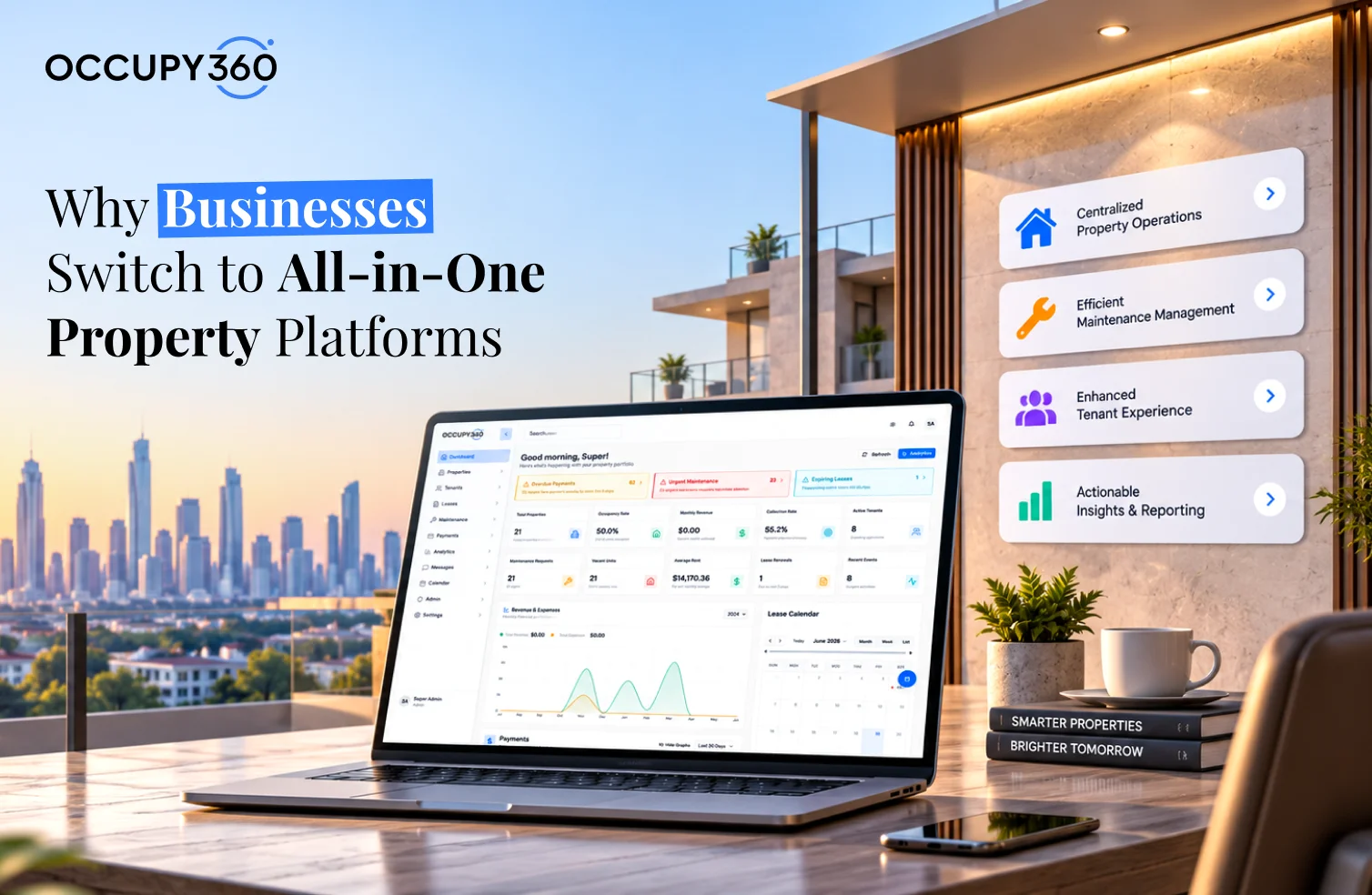
Businesses are moving from disconnected property tools to one property operations platform because managing leases, maintenance requests, payments, tenant communication, and reports across separate systems creates more work than it solves. When operational information is spread across spreadsheets, emails, messaging apps, accounting software, and standalone maintenance tools, teams often face duplicate data entry, missed requests, inconsistent processes, and limited portfolio visibility.
An all-in-one platform addresses these gaps by bringing core property operations into one connected environment. Teams can coordinate tasks, standardize workflows, track responsibilities, and access real-time information without repeatedly switching between systems or manually reconciling records.
For growing property businesses, this makes technology consolidation more than a software decision. It becomes an operational strategy for improving accountability, tenant service, process consistency, and control across every property.
Key Takeaways
- A single property management platform connects tenant requests, maintenance, workflows, communication, payments, and reporting.
- Multiple tools often create duplicate records, fragmented communication, manual follow-ups, and inconsistent processes.
- Property management workflow automation can route requests, assign responsibilities, track deadlines, and escalate delays.
- Platform ROI should be calculated using time savings, reduced software costs, fewer errors, faster resolution, and improved portfolio visibility.
- Occupy360 is designed to centralize requests, standardize workflows, and provide operational visibility across multiple properties.
Why Do Multiple Property Management Tools Create Operational Problems?
Multiple tools create problems when data, communication, and responsibility do not move together.
A tenant may report an issue through email. A property manager may record it in a spreadsheet. A maintenance team may discuss it through a messaging application. The invoice may then be processed in a separate finance system. Although every team uses software, no single system shows the complete status of the request.
This fragmentation commonly causes:
- Repeated data entry
- Delayed task assignment
- Missed or duplicated requests
- Inconsistent workflows between properties
- Limited reporting across the portfolio
- Unclear responsibility for open tasks
- More time spent preparing management updates
- Difficult onboarding for new staff
The problem is not always a lack of technology. It is often a lack of connection between the technologies already being used.
What Is an All-in-One Property Operations Platform?
An all-in-one property operations platform is a centralized system used to manage recurring activities across properties, tenants, teams, vendors, and leadership.
Depending on the platform’s scope, it may bring together:
- Tenant and occupancy management
- Lease records and renewals
- Rent and payment tracking
- Maintenance requests
- Work-order assignment
- Inspections and approvals
- Team and vendor communication
- Task escalation
- Documents and activity histories
- Multi-property dashboards
- Operational reports and analytics
A property operations platform is broader than a basic property rental platform that primarily advertises units or processes bookings. It focuses on how day-to-day operations are captured, assigned, completed, monitored, and reported.
How Does One Platform Improve Property Management Workflows?
One platform improves workflows by keeping each request, action, update, and responsibility within the same operational record.
Consider a maintenance request for a water leak:
- The tenant submits the issue.
- The platform records the request.
- The issue is categorized by urgency and property.
- The relevant team or vendor is assigned.
- Deadlines and service levels are applied.
- Communication remains attached to the work order.
- The property manager tracks progress.
- The tenant receives updates.
- Completion evidence is recorded.
- Management can review resolution time and recurring issues.
With separate tools, these steps may be spread across emails, telephone calls, spreadsheets, and accounting software. With property management workflow automation, the process can follow predefined rules from request creation to closure.
Automation does not remove the need for human judgement. It reduces the manual coordination required to move routine work forward.
Read More: How Landlords Can Increase On-Time Rent Payments Using Occupy360
What Are the Main Benefits of One Property Management Platform?
1. One operational source of truth
A unified platform gives authorized users access to the same current information. Teams no longer need to compare spreadsheets, message histories, and separate databases to determine what happened.
2. Faster request handling
Requests can be automatically assigned based on property, issue type, urgency, technician skill, or team availability. This reduces the time between reporting and action.
3. Consistent execution across properties
Standardized workflows help each location follow the same operational process while allowing adjustments for property-specific needs.
4. Clear accountability
Every task can have an owner, status, deadline, and activity history. Managers can identify where work is delayed without repeatedly contacting staff for updates.
5. Better tenant communication
A connected tenant management platform can keep request updates, messages, and resolution details together. Tenants receive clearer information, while teams avoid repeated enquiries about status.
6. Portfolio-wide visibility
Leadership can compare open requests, response times, workloads, recurring problems, and completion rates across multiple properties.
7. Simpler technology administration
Consolidation may reduce the number of integrations, user accounts, renewals, data exports, and training processes the business must manage.
These benefits depend on successful implementation. Buying a platform does not automatically improve operations. Workflows, permissions, data quality, responsibilities, and adoption must also be addressed.
Can a Property Operations Platform Automate Maintenance Requests and Work Orders?
Yes. A property operations platform can automate several stages of maintenance request and work-order management.
Common automation capabilities include:
- Creating a ticket from a tenant submission
- Categorizing requests by issue type
- Flagging emergencies
- Assigning work based on location or technician
- Setting response and completion deadlines
- Sending reminders and escalation alerts
- Updating tenants when the status changes
- Recording photos, notes, and completion evidence
- Closing requests after approval
- Reporting on response time and recurring faults
AI-enabled systems may also analyze request descriptions, images, and historical records to support categorization or troubleshooting.
Automation works best when escalation rules and human oversight are clearly defined.
What Is the ROI of Switching to an All-in-One Property Operations Platform?
The ROI comes from reducing operating effort and avoidable costs while improving service speed, control, and decision-making.
A simple annual ROI calculation is:
ROI (%) = [(Annual measurable benefit − Annual platform cost) ÷ Annual platform cost] × 100
For example, assume a business estimates:
- $24,000 in staff time saved
- $8,000 in replaced software subscriptions
- $6,000 in reduced administrative and reporting work
- $2,000 in avoided errors and missed-service costs
- $20,000 in annual platform and support costs
The total measurable benefit would be:
$24,000 + $8,000 + $6,000 + $2,000 = $40,000
The ROI would be:
ROI = [($40,000 − $20,000) ÷ $20,000] × 100 = 100%
This means the estimated net benefit equals the annual platform cost. This example is illustrative and does not guarantee the same return for every business.
A credible business case should measure:
| ROI area | What to measure |
|---|---|
| Administrative time | Hours spent entering, transferring, and reconciling data |
| Maintenance efficiency | Assignment time, response time, resolution time, repeat visits |
| Software consolidation | Licences, integration costs, support fees, and renewals replaced |
| Reporting | Time required to prepare portfolio and management reports |
| Tenant service | Missed requests, repeated enquiries, complaint rates, satisfaction |
| Staff onboarding | Time needed for new team members to understand tools and processes |
| Risk reduction | Missed deadlines, incomplete records, access issues, and process variation |
Businesses should establish baseline figures before implementation and compare them with results after adoption. Without baseline data, we cannot confirm whether the platform produced a measurable return.
How Much Does a Property Operations Platform Cost?
A property operations platform may be priced per property, unit, user, module, transaction, or portfolio. Some providers use monthly subscriptions, while enterprise systems may require custom pricing.
The total cost can include:
- Platform subscription
- Selected modules
- Number of users or units
- Data migration
- Workflow configuration
- System integrations
- Tenant or mobile applications
- Implementation support
- Staff training
- Custom reporting
- Security requirements
- Ongoing technical support
A smaller business using standard workflows will usually require less configuration than a multi-country property group with custom approvals, legacy integrations, and complex reporting.
How Does AI Improve Property Operations Management?
AI improves property operations by helping teams classify information, identify patterns, prioritize work, and automate repetitive decisions.
Potential applications include:
- Categorizing tenant requests
- Detecting urgent maintenance issues
- Suggesting troubleshooting steps
- Predicting equipment maintenance needs
- Identifying repeated faults
- Summarizing operational reports
- Forecasting workload
- Detecting unusual payment or activity patterns
- Supporting natural-language search across records
- Recommending task assignments
AI should support rather than replace operational controls. Property teams still need to review high-risk decisions involving safety, tenant rights, financial actions, access, compliance, or vendor authorization.
The value of AI also depends on data quality. Incomplete property records, inconsistent issue categories, and fragmented historical data will limit the reliability of recommendations.
Why Are Rent Payment Platforms More Useful When Connected to Operations?
Standalone rent payment platforms may collect and record payments effectively, but payment data becomes more useful when connected to tenants, leases, properties, communications, and operational responsibilities.
A connected system can help teams:
- Match payments to the correct lease
- View outstanding amounts with tenant records
- Automate reminders
- Record payment-related communication
- Track renewals and move-in requirements
- Prepare consolidated portfolio reports
- Reduce reconciliation between systems
However, payment security, regional regulations, supported currencies, accounting integrations, and transaction fees must be evaluated separately. A platform should not be selected solely because it offers payment processing.
How Should Businesses Choose the Best Property Management Software?
The best property management software is the platform that matches the business’s operating model, property portfolio, integration needs, security requirements, and growth plans.
Before selecting a system, evaluate:
- Operational coverage: Does it manage the workflows that consume the most time?
- Multi-property support: Can teams compare and control operations across locations?
- Automation flexibility: Can workflows, approvals, and escalations be configured?
- User experience: Can property teams, tenants, and vendors use it easily?
- Integration: Does it connect with accounting, access, payment, and existing systems?
- Reporting: Does leadership receive useful real-time information?
- Security: Are permissions, audit histories, backups, and data protections adequate?
- Implementation: Is migration, configuration, training, and support included?
- Scalability: Can the system support more properties, users, and workflows?
- Evidence: Can the provider demonstrate relevant deployments and measurable results?
Businesses should test real workflows during a product demonstration rather than relying only on a feature checklist.
How Occupy360 Supports Connected Property Operations?
Occupy360 brings tenant requests, maintenance activities, workflows, communication, and portfolio-wide visibility into one structured property management platform.
It helps property managers, facility teams, and operations leaders manage requests from submission to resolution, assign responsibilities, track progress, standardize recurring processes, and monitor performance across multiple properties.
By keeping operational data, task updates, communication, and reporting within one system, Occupy360 can reduce manual coordination, improve accountability, and give teams a clearer view of what is happening across their property portfolio.
In this article